Your Cart
Your Cart is currently empty.



An Invitation
What if the part of you that you are trying so hard to fix is actually trying to tell you something?
Created by Marian Ganciu for those who no longer want only to manage symptoms, but want to understand the deeper patterns shaping their experience of health, life and restoration.
Created by Marian Ganciu, founder of The EIKODOS Method.
Many people have spent years trying to manage their anxiety, improve their sleep, ease persistent tension, navigate difficult relationships or understand recurring emotional patterns. They have tried individual solutions — sometimes many of them — and yet something remains unresolved. Not because those solutions were wrong, but because what may be missing is not another isolated intervention. What may be missing is a framework for understanding how the different dimensions of a human life connect, influence one another, and call for a different kind of attention altogether.
I
There is a quiet assumption beneath much of modern health practice: that symptoms are errors, malfunctions, failures of the body to perform as it should. But what if some of those symptoms — the fatigue that refuses to lift, the anxiety that returns despite every technique, the tension that settles in the same place year after year — are not breakdowns at all? What if they are meaningful expressions of adaptation, the body's faithful attempt to manage what it has been asked to carry?
This is not to suggest that every symptom has an emotional cause, nor to replace appropriate medical evaluation or treatment. It is simply an invitation to curiosity — to consider that the body may be communicating something worth understanding before it is silenced. Whole-person understanding begins here: not with a verdict, but with a question.
II
The modern world tends to divide the human person into departments. One professional for the body. Another for the mind. Another for relationships. Another still for the spirit. And while each may offer genuine help within its domain, the person who walks between those rooms remains one person — undivided, interconnected, living as a whole. Stress shapes sleep. Sleep shapes mood. Mood shapes relationships. Relationships shape beliefs. Beliefs shape how the body responds to the world. Nothing operates in isolation.
You do not live in separate systems. You live as one person.
The EIKODOS Method begins from this premise. It does not treat the body as separate from the emotional life, nor the nervous system as independent from relationships, nor the spirit as unrelated to physical health. It works with the whole person because that is how a person actually lives — nutrition, environment, emotional experience, nervous system patterns, relational life, and spiritual orientation all woven into a single story.
III
There is nothing wrong with wanting symptoms to ease. But there is a difference between managing what troubles you and restoring what has become fragmented. The first reduces discomfort. The second invites a person back toward coherence — toward a way of living in which the body, the nervous system, the emotional life, relationships, and the deeper self begin to move together again rather than pulling in different directions.
The movement that The EIKODOS Method traces is not from brokenness to perfection. It is from fragmentation toward integration, from survival toward presence, from merely functioning toward flourishing. Restoration does not mean the absence of all difficulty. It means becoming a person who can meet difficulty with greater wholeness, greater honesty, and greater freedom.
IV
The body does not communicate in words. It communicates through patterns, sensations, rhythms and adaptations. Persistent fatigue may be more than a nutrient deficiency. Anxiety that surfaces in the same circumstances may carry information about something older. Tension that settles in the shoulders or the stomach, digestive discomfort that worsens under pressure, sleep that fragments despite every protocol — these may be the body's faithful, if inarticulate, language.
The question is not only, 'How do I silence this symptom?' but also, 'What has my body been trying to communicate?'
Learning to attend to the body's language is not a mystical practice. It is a form of honest self-knowledge — one that requires patience, a willingness to listen, and a framework generous enough to hold what is discovered without rushing toward a premature solution.
V
Consider the possibility that your body has been working on your behalf for longer than you realise. What has happened to you? What environments did you grow up in? What did your nervous system learn to expect? How has your body adapted to protect you from overwhelm, from rejection, from pain that was once too great to hold? What has it been faithfully guarding, even at a cost?
These are not questions designed to frighten or to diagnose. They are invitations to recognition — to a kind of seeing that is gentle rather than clinical, curious rather than accusatory. Many people find, when they begin to look with this kind of attention, that their bodies have been remarkably faithful. The patterns that trouble them now were once adaptations that served them well. Understanding this changes everything about the relationship a person has with their own health.
VI
The EIKODOS Method is not a rigid protocol. It does not offer a universal sequence of steps that every person must follow in the same order. People carry different histories, different nervous systems, different relational patterns, different spiritual orientations, and different needs at different stages of their lives. A method that respects the person must be able to hold that complexity.
What EIKODOS offers instead are principles and orientation — a way of seeing, a way of understanding the human person, and a way of engaging with restoration that can be applied with wisdom and discernment to any individual's particular situation. It is a compass, not a conveyor belt.
VII
The EIKODOS Method works through five movements — not as a mechanical checklist to be completed, but as a living rhythm to be inhabited. They are not strictly sequential; they overlap, revisit one another, and deepen over time. They describe not what you must perform, but what restoration tends to look like when a person is genuinely attended to as a whole.
Seeing
The first movement is honest perception — learning to see what is actually present in your body, your patterns, your relationships and your inner life, without rushing to interpret or fix. Restoration begins with truthful attention.
Understanding
The second movement is making sense of what has been seen — placing symptoms, patterns and adaptations within a larger story. Understanding asks: How did this come to be? What has it served? What is it connected to?
Nourishing
The third movement is providing what the person actually needs — not merely what removes discomfort, but what genuinely feeds life. This includes physical nourishment, relational safety, rest, movement, beauty and spiritual participation.
Integrating
The fourth movement is allowing what has been fragmented to come together again. Integration is not a single event but a gradual settling — the body, mind, emotions and spirit learning to move as one rather than pulling against each other.
Becoming
The fifth movement is ongoing — it is the person growing into greater freedom, greater love, greater participation in life. Becoming is not a destination but a direction: the lifelong unfolding of who you were created to be.
VIII
Living systems do not grow through intensity. They mature through rhythm.
Restoration is not accomplished through a single heroic effort. It is woven from repeated ordinary choices — the rhythm of nourishing food, restorative sleep, honest relationship, gentle movement, quiet reflection, and faithful participation in life. These are not glamorous interventions. They are the patient, daily soil in which a human person grows. Trust the rhythm. It is more powerful than intensity.

IX
Within the larger vision of EIKODOS, nourishment extends beyond what can be measured in laboratories. Medicinal plants, whole foods, clean water, sunlight, forest air, seasonal rhythms — these are not alternative treatments or exotic additions. They are part of the wisdom of creation, available to those who approach them with stewardship, gratitude and moderation rather than extraction or exaggeration.
Clinical herbalism, as practiced within this framework, is not magic. It is attentive participation in the nourishing gifts of the natural world — used wisely, used humbly, used as one thread within a larger tapestry of care. The earth offers more than we often remember to receive, and receiving well is itself a form of restoration.
X
A healthier body, a calmer nervous system, nourishing food, restorative sleep, meaningful relationships — these are genuinely good things. But within the vision of The EIKODOS Method, they are not ultimate goals in themselves. They are conditions. They are the soil in which something deeper can grow.
Physical health supports a person in living more freely. Emotional stability allows a person to love more deeply. Relational safety creates space for vulnerability and growth. And all of these together support what may be the deepest human need: to participate more fully in life, in relationship, in meaning, and in the kind of inner transformation that no technique alone can produce.
XI
At its deepest level, The EIKODOS Method is shaped by an anthropological vision rooted in the Christian tradition — a vision that understands the human person not merely as a biological system to be optimised, nor as a psychological self to be managed, but as a being created for communion, transformation, and love. The human vocation, within this vision, is not survival or comfort. It is to become more fully the person one was created to become.
This is offered with warmth and intelligence, never as a requirement or a condition of engagement. It is the soil from which the method grew — a tradition of understanding human wholeness that spans centuries, that honours body and spirit together, and that believes restoration is not merely possible but is, in fact, what we were made for.
About the Author
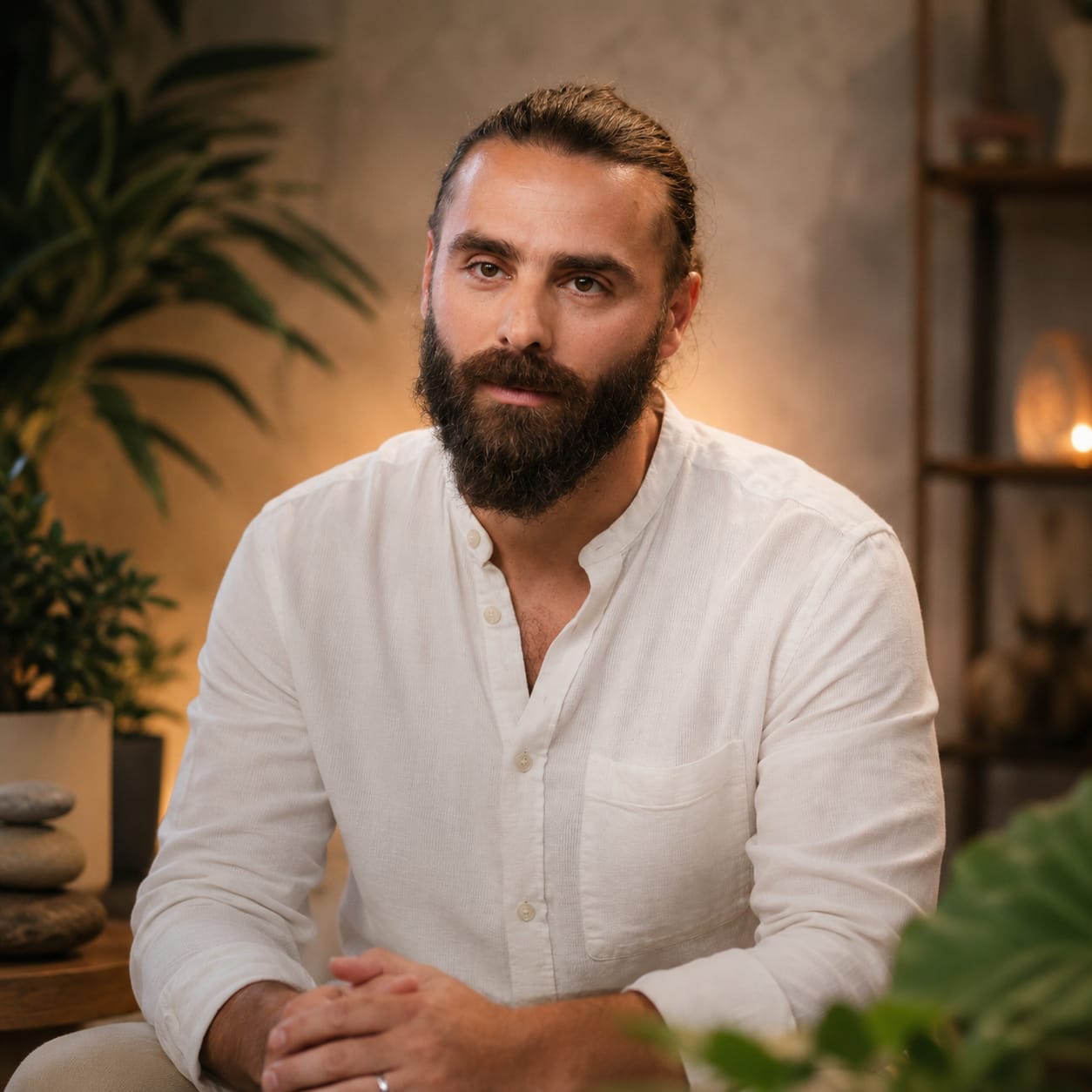
Marian Ganciu is the creator of The EIKODOS Method and founder of Herb Explorers. He is an interdisciplinary practitioner whose work brings together evidence-informed health sciences, somatic healing, applied psychosomatics, clinical herbalism, lifestyle medicine and the anthropological wisdom of the Christian tradition.
His work is shaped by a conviction that the human person deserves to be understood as a whole — not reduced to a diagnosis, a data point, or a collection of symptoms, but met with the kind of attention that honours the full complexity and dignity of being human.
You do not need to become someone else. You do not need to fight yourself. You may begin by learning to see differently.
If you recognise yourself in this way of seeing the human person, the next step is not to collect more information. It is to begin exploring your own story with greater attention, wisdom and compassion.
În ultimele câteva decenii, discuțiile despre sănătatea mintală au devenit din ce în ce mai f
Mintea poate înțelege un adevăr cu mult înainte ca întreaga ta ființă să învețe să trăia
<!doctype html> An Invitation What if the part of you that you are trying so hard to fix is ac





Lasă un răspuns